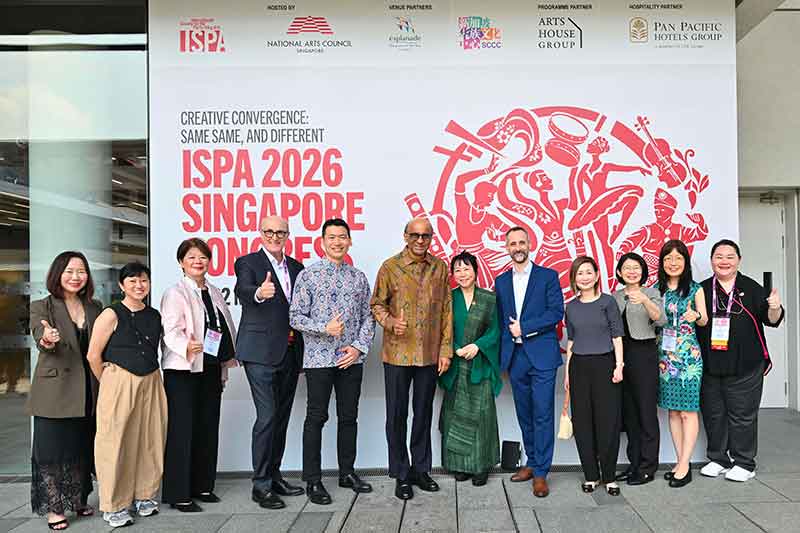
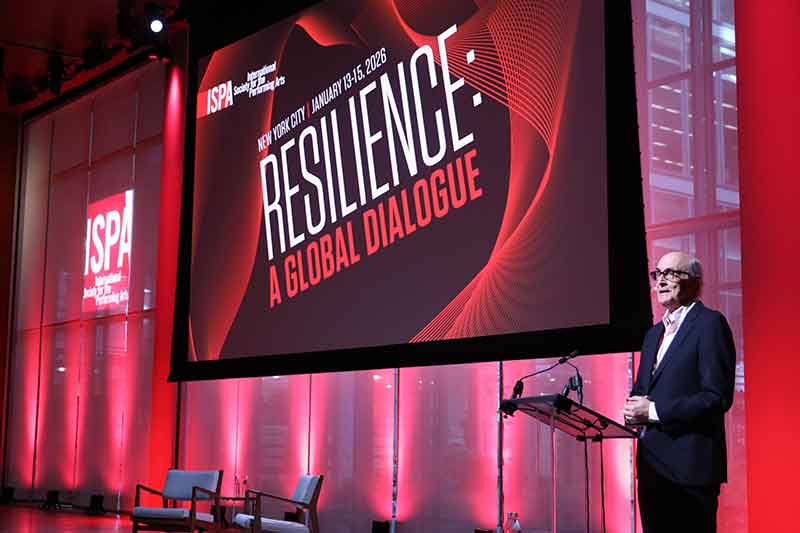
The International Society for the Performing Arts (ISPA) is a global network of over 500 leaders from 60 countries, dedicated to strengthening and advancing the performing arts worldwide.
Through its congresses, leadership programmes and year-round initiatives, ISPA fosters connection, exchange and innovation across the international arts community.
ISPA’s Fellowship Program supports emerging and mid-career arts leaders worldwide through congress participation and leadership development. Alongside its Global Program, ISPA offers 11 Regional Fellowships in partnership with regional funders.
Upcoming Events
ISPA Series at the Fringe
October 2026
ISPA 2027 New York Congress
12–14 January 2027
Join ISPA’s Membership today and be part of the network shaping the future of the arts, visit www.ispa.org
Hear from members of the International Society for the Performing Arts (ISPA) about their work across global regions
Beyond the building:
How university stages present, connect and support each other
We spoke with two leading figures from Major University Presenters (MUPs), both of whom are long-standing ISPA members: Mary Lou Aleskie, Executive Director of the Hopkins Center for the Arts at Dartmouth College (the smallest member of the Ivy League), and Chad Herzog, Executive and Artistic Director of Arizona Arts Live at the University of Arizona. They are based at very different institutions – one a small, rural institution in New England and the other a large public land-grant university in the desert Southwest – but both bring decades of experience presenting work within higher education.
How is presenting within a university different from presenting in a traditional arts organisation?
Chad Herzog (CH): Within a university we have an incredible group of researchers and educators to draw on. At the University of Arizona we’re a land-grant institution, so it’s part of our role to reach the entire region, not just Tucson; our stage is really Southern Arizona, not one building. We also don’t operate like a traditional roadhouse, where an artist gets off the bus, performs and leaves. It’s rare for someone to be with us for just one night; instead, they’re usually here a minimum of three days, often more, integrated throughout the university and the community. A string quartet isn’t just playing with our string musicians – they’re in class with engineering students. A puppet company works with our theatre students, but also with medical students. That extra time embeds artists in the community, so they understand why we do what we do, and so our researchers can use the arts to tell their own work’s story to people outside their field.
Mary Lou Aleskie (MLA): Dartmouth College is in a rural environment, and connecting to nature – its beauty and its destructive power – sits at the centre of our educational practice. We’re a liberal arts institution, so we’re interested in context as much as the thing itself. That gives us permission to experiment, to develop new ideas and to let the arts sit at the heart of an educational process that doesn’t always result in someone becoming a professional artist; more often it results in a lifelong love of the arts. That’s our differentiator from organisations focused on production and the success of that product: we get to treat the process itself as the product. We’ve had a 35-year relationship with New York Theatre Workshop, one of the most prolific developers of new theatre in the country, which lets our campus witness the creative process first-hand before that work reaches Broadway or tours elsewhere.
CH: I’d frame it as taking calculated risks. That willingness is central to what a university presenter has meant in this country for a long time: being the place where new work is made, seen and celebrated. I’d also echo what Mary Lou said about the place. We sit in a border city, less than an hour from Mexico, so artists from Mexico aren’t “international” to us – that’s our region. The border only exists on our maps.
Where do you see the strongest intersections between the academic and artistic sides of your work?
MLA: International work looks different from within a university, and this is where I see the strongest overlap with research. It used to be about touring: organising international tours and collaborating that way. Now the research side of what we do has elevated things to real co-creation with partners abroad. Our orchestra collaborates with conservatories in Tuscany and tours Italy with them, playing repertoire neither group could do alone. We also work with UNAM [National Autonomous University of Mexico] in Mexico City on a commissioning programme that lifts up Mexican composers. That means our student bands, not just professional orchestras, can perform authentic repertoire that resonates with our growing Latin American student population. That’s a more lasting way for universities to elevate the arts beyond a single night on stage. Climate is another area where this comes up: there’s hardly an issue more borderless. We think a lot about “climate hope” here, using the arts to communicate not just the tragedies but the possibilities, which is very much part of our educational mission.
CH: On our end, the university becomes a research resource for artists building something that does not exist yet. They have access to specialists, archives and laboratories that most presenters could not offer on their own, and that access shows up in the work. In the last six years we have commissioned more than 20 pieces here, and several are now playing on stages a long way from Southern Arizona. A commission does not only bring something into our region – it sends something out of it.
How does the university context shape the kinds of artists and work you choose to present?
MLA: Some institutions allow someone like Chad to walk in and reawaken the value of the arts on a campus that may have lost sight of it. Others are rigidly focused on turning out the next donor and have a narrow view of the arts or emphasise only professional artist training. And because we report to university administrators rather than a dedicated arts board, leadership turns over fast: I’ve had five provosts in nine years. You can watch an institution go from centring the arts to something entirely different within months of a new leader arriving.
On the international side, Dartmouth has a significant Arctic studies programme and a history closely tied to Indigenous and Native practices, so we look for artists from those backgrounds. Around 32 per cent of our students come from other countries, so we try to reflect the places they’re from. And because we’re rural, most of our neighbours aren’t regularly getting to New York or Boston, so part of our job is bringing them a window onto the world that isn’t filtered through distorted lenses, while asking whose stories aren’t being told and who needs to feel more at home here.
CH: At a large state university, not every student gets to study abroad. Working closely with our international and study-abroad offices as we bring artists to campus lets us create a real international experience without a passport in hand. In a moment when globalisation makes everywhere feel the same, bringing people here shows our community that the world is at once similar and completely different – and that we can still come together, share a meal and experience something on stage.
What do you find most valuable about connecting with other university presenters?
CH: Major University Presenters (MUPs) has evolved a lot over the last 25 years – it’s increasingly a group of people who share similar goals and challenges, figuring out how to navigate this moment together. It’s become a genuine resource, not just for those of us who lead these programmes, but for the colleagues who work alongside us on our campuses. Our financial services and production teams now have a network of counterparts across 21 other universities. We’ve been able to flag issues happening globally and how they might affect us as a group going forward, and to be there for each other when something like a provost or president change means a colleague goes from nearly fully funded to having their budget nearly zeroed out. We have members who receive zero financial support from their university, one who receives 93 per cent of their operating budget from theirs, and everything in between. How do we all navigate that so our work stays a vital part of the university experience?
MLA: It’s a vital and evolving network, and new leaders in new places are helping it grow, like Chad, who’s stepped into a leadership role. There are 22 members currently, chartered for up to 25, and our budgets range from about $2 million to $35 million. Add that up, and that’s something like $100 to $125 million of arts investment in the hands of 22 people. That’s quite influential, especially spread across the country, into rural and remote areas. That’s an important core of consistency in a sector that’s seeing so much erosion right now, and within the group there’s real accountability, not just to our own institutions but to the integrity of each other. I don’t agree with every choice every member makes, but I believe in the integrity of our colleagues and the intention behind how those resources are deployed.
CH: And whether you’re talking federal, state or regional dollars, that collective impact is so much greater together. I’d also add that being a university presenter is as much about community as it is about students, faculty and staff. We often call ourselves the front door to the university – someone’s first time on campus might be walking into our centre, or their first connection to the University of Arizona might be us showing up in their high school auditorium or doing a pop-up performance on the street. Our universities are training the next doctors, engineers and musicians; our job is to train the next generation of arts and culture-goers. We want everyone at the University of Arizona to have an Arizona Arts Live experience before they graduate, because if they don’t have that experience today, we won’t have an audience tomorrow.
Join ISPA at the New York Congress (12–14 January 2027), and at the mid-year congress in Uppsala, Sweden (8–11 June 2027).
For more information on ISPA’s congresses and upcoming programmes, visit www.ispa.org