As the International Society for the Performing Arts (ISPA) prepares for its January 2026 Congress in New York, its Planning Committee – co-chaired by Josephine Ridge of Banff Centre for Arts and Creativity (Canada) and Paul Tam of the West Kowloon Cultural District Authority (Hong Kong) – has been shaping a programme that aims to meet this complex moment for arts and culture head-on.
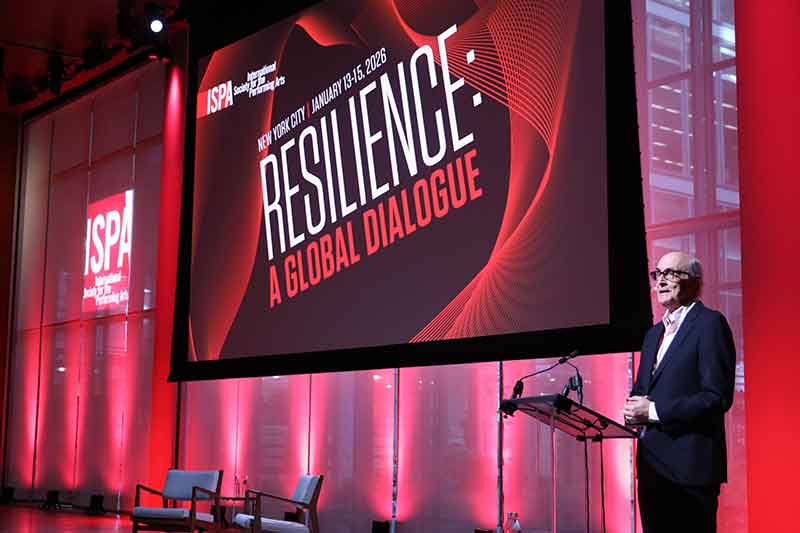
Under the theme ‘Resilience: A Global Dialogue’, NY26 will convene arts leaders from across continents to address shared challenges, from funding uncertainties to geopolitical tensions, while exploring how creative practice, cross-sector collaboration and new technologies might help chart a way forward.
In this conversation, Ridge and Tam reflect on how the theme emerged, the ideas driving the programme, and why, in a period of deep uncertainty, solidarity among international colleagues remains not only valuable but vital. Read on to discover what’s in store and why NY26 promises to be a congress you won’t want to miss.
How did you arrive at NY26’s theme, “Resilience: A Global Dialogue”?
Josephine Ridge (JR): One of our starting points was that we needed to find a way to acknowledge that there are many challenges, either regionally specific or globally resonant. And we wanted to try to find a way to address those, but in a constructive way – and hopefully a way that can enable congress attendees to feel that they’re leaving with the sense that there are positive pathways and opportunities. Where there’s shared experience, people can learn from each other about their approaches. And where there are really specific challenges that people in different regions are encountering, they are able to actually talk in a supportive environment about their experiences.
Paul Tam (PT): When we first started out, we were looking at different options for themes, and this one really stood out because I think it’s so timely. Every corner of the world is dealing with geopolitical tension, financial pressures and sustainability. These are very pressing issues. Resilience represents our attitudes towards all these issues at hand and how we can band together and be resilient in the face of the tides of change. It’s also very much part of our DNA.
JR: Exactly. We have to think of it through the lens of working in a creative space, a cultural space. We know the power of culture and the arts, and resilience is where you can find that intersection between recognising challenges and finding hope.
Are there any sessions you’re most looking forward to?
JR: One of the areas I’m really interested in is what we can learn from other sectors – people working in creative areas that are perhaps tangential to our work. The first session, which is talking about cross-sector collaboration, is really challenging us to explore innovative and creative ways of thinking about some of the challenges and opportunities.
PT: I’m going to speak on the panel about funding, and I think this is very much on everyone’s mind these days because governments are cutting back, corporations are reducing support, and without resources, the arts just cannot go on. I represent Asia – I’m based in Asia, so I feel a responsibility to represent the region. I’m familiar with the funding landscape in this part of the world, and I really think we’re there to learn from each other about all these new, innovative and creative ways of funding to support our arts.
I’m also really interested in Session Five, which focuses on creative resistance, and how the arts respond to conflict and crisis. This is one of the other major concerns occupying people’s minds at the moment. It’s not just about geopolitical issues but also economic volatility. In the West, in Europe, in America, and in Asia, there are different kinds of issues coming at us from all sides. How do we resist? How do we bounce back? That’s the panel I look forward to the most.
Were there sessions that were particularly challenging to shape?
JR: The most challenging aspect was to consider how we meaningfully tackle the issue of AI and technology. I don’t think there’s a conference in the world right now that takes place without a session on the rapid changes in that area. How do we tackle that? Who do we bring into the room? What are the questions? How do you make it more than just an information session about what AI is, where everybody comes out saying, “What do I do with that?” How do you actually make that meaningful?
PT: That’s the topic I want to avoid the most. It’s scary to me, AI. But it’s something we cannot turn away from, and we need to learn. As old as I am, I still have to learn because this is the future of arts and culture. David Baile, ISPA’s Chief Executive, said that everyone he has seen on AI panels tries to skirt the issue. Even those invited to speak feel scared about the topic. I think this is going to be a very interesting conference because those on the AI panel are truly experts in it and are unafraid to speak their minds.
Why is it important for international colleagues to gather at this moment?
PT: It’s important that everyone comes to New York in January because I think it’s a sign of solidarity. Talking about the theme of resilience, the most important thing is that we band together as a single unit. That would actually be the strongest expression of resilience. Numbers are important. People from Canada, from Asia, from the UK, from Africa, from South America, Mexico – they should all come to New York in January.
JR: That message of solidarity is really important. By bringing everyone together from different parts of the world, we’re also reminding ourselves that we have shared challenges and common ground, even where there may appear to be quite different circumstances. There really is so much shared experience because we’ve all chosen to be in this world of arts and culture and to use it as our means of expression, and to find pathways and solutions.
It’s really important to be in that shared space together, because even if challenges might feel insurmountable, being with others – listening, working and problem-solving collectively – creates a strength of its own. In that environment, where colleagues are supportive, constructive and willing to face issues head-on, you can feel less isolated and find the collective support our global community brings.