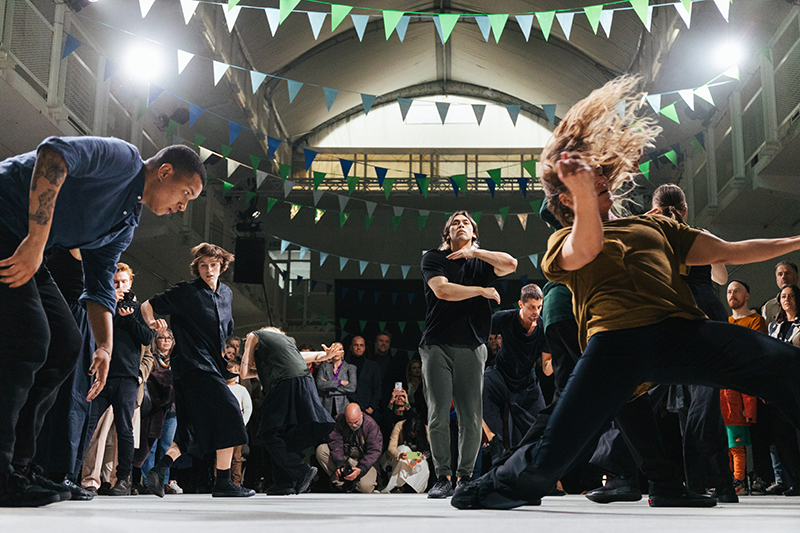
As Theater der Welt 2026, Germany’s largest international festival for contemporary performing arts, prepares to unfold in Chemnitz, Nikos Mavrakis, an ISPA Global Fellow and founder of Athens-based company TooFarEast, reflects on how the festival’s global scope takes shape within the regional context of Germany.
Held once every three years, the 2026 edition brings together nine curators from around the world, each contributing their unique regional perspectives to the programme.
The unique format proposed for Theater der Welt 2026 was the reason I applied. As an alumnus of The Festival Academy, the idea of curating through a genuinely collective and experimental model was something we often imagined in theory, and here was the chance to put it into practice.
I didn’t necessarily picture myself in this role; I was touring with the companies I was producing, attending performances across festivals, learning through proximity, curiosity and conversation. Those experiences – being on the road, listening, observing artistic ecosystems first hand – became the foundation that shaped my curatorial outlook.
When the nine of us first gathered in February, we rolled up our sleeves and mapped our regions from our own lived perspectives. We didn’t need to impose a festival concept from above. Our shared process – nine co-curators, nine regions, nine distinct artistic and political realities – is the concept. Our curatorial method is polyphonic – we discuss, disagree, adjust, cross paths and collectively weave a programme that listens to the world.
In this structure, curating from within Europe holds a particular meaning. For too long, Europe has assumed the position of the interpretive centre – the lens through which the rest of the world is expected to pass for validation. This perspective is not only outdated, but increasingly irrelevant – and even dangerous. It has shaped institutions of oppression and exploitation in ways that flatten rather than cultivate plurality. This festival offers the opportunity to step decisively away from that frame. Here, Europe is not the reference point nor the central focus; it is one voice among many. This allows for more honest questions about Europe’s cultural identity – what it is today, and who creates within it. Europe is already composed of layered migrations, diasporas, frictions and solidarities. My focus is not to define a European identity, but to acknowledge the continent as a crossroads of many worlds.
Within this framework, Germany is not positioned as the decision maker or interpretive authority. It becomes the place where these worlds coexist. Chemnitz, especially following its year as European Capital of Culture 2025, becomes a host, a meeting point – a temporary space for shared exchange. My background as a producer reinforces this approach: producing, for me, is about creating conditions of trust, care and continuity that ensure artists are supported and heard on their own terms.
Nikos Mavrakis, a 2026 ISPA Global Fellow, is one of the nine curators of Theater der Welt 2026 and comes to the festival from Greece. Nikos is the founder of the Athens-based company TooFarEast and also works with the Amalia Theatre and Mario Banushi.