Interview by Gilles Doré with Kerfalla Camara (Director, Circus Baobab) and Abdramane Kamaté (Executive Director, African Performing Arts Market, MASA)
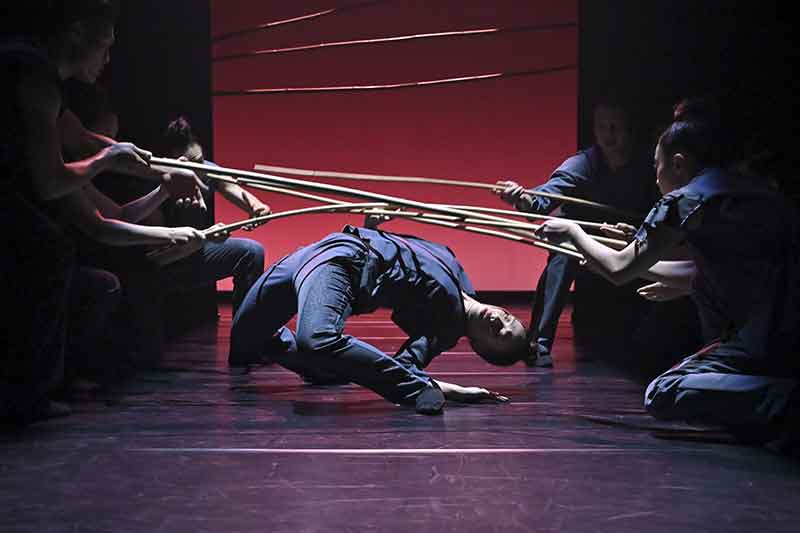
Through the African Performing Arts Market (MASA), an international organisation dedicated to the development and promotion of African performing arts, and Circus Baobab, a leading figure in Guinea’s contemporary circus scene, two complementary models are emerging that reflect the evolution of their countries’ cultural scenes and their international influence.
Africa is a vast and diverse continent. In this article, CINARS focuses on a performing arts market and a performing arts company to offer a compelling glimpse into this rich and vibrant continent.
What stereotypes or preconceived notions about African performing arts still persist in international networks?
For Abdramane Kamaté, the primary stereotype is referring to “African art” as a homogeneous bloc: “Africa is not a country; it is a continent of 54 countries, with an extraordinary diversity of cultures, aesthetics and artistic trajectories.” He adds that international professionals would benefit from coming “without preconceived expectations” to discover a scene “of remarkable richness and inventiveness.”
Richard Djoudi and Kerfalla Camara, for their part, point to a persistent neocolonial lens that too often reduces African performing arts “to a form of authenticity, tradition or social engagement, rather than recognising them for their diversity and artistic rigour.” Their observation echoes that of Kamaté, who feels it is time to “stop viewing African artists as on the periphery of global creativity, but rather as actors who are fully redefining its boundaries.”
Are collaborations between African countries growing stronger?
Kamaté has no doubt: “African collaborations are no longer an ambition; they have become a reality.” For him, MASA is proof of this: “At each edition, professionals from across the continent come together to explore new partnerships.” He also emphasises that “exchanges between Francophone, Anglophone, Lusophone and Arabic-speaking communities are becoming increasingly frequent.”
Circus Baobab shares this observation: “We’re seeing the emergence of new co-productions, artist residencies, training networks and festivals that foster exchanges,” explains Camara. For the company, these South-South collaborations make it possible to “develop models adapted to African realities while enhancing the international visibility of these productions.”
Since its creation, how has MASA’s role evolved in shaping African professional networks?
“MASA began as a performing arts market,” recalls Kamaté. “Today, it has become a true ecosystem.” Beyond promoting works, the institution now supports “artists, producers and cultural entrepreneurs through training, mentoring, incubation via the MASA Lab and networking.” This support is intended to be ongoing: “We want to be there for them throughout their careers, not just during a week-long festival.”
From Circus Baobab’s perspective, what are the most significant changes currently taking place in the performing arts in Africa?
For Djoudi and Camara, the transformation is profound: “A new generation of artists is asserting its own narratives, aesthetics and creative models, while addressing major social issues.” This dynamic, they explain, is particularly visible in contemporary circus, “which has become a tremendous space for creation, transmission and inclusion for young people.”
Your productions are deeply rooted in your Guinean reality while speaking to audiences around the world. How do you strike this balance?
This response from Circus Baobab’s Camara sums up the spirit of this generation of artists: “We are convinced that universality stems precisely from being rooted in one’s culture, not from erasing one’s identity.” There is no desire to pander to an outside perspective, as Camara explains: “We do not seek to meet external expectations or adapt our circus to a foreign viewpoint. Above all, we strive to be sincere and exacting in the stories we tell.” And it is precisely this authenticity that resonates with audiences around the world: “The circus possesses a universal power: it expresses itself through the body, emotion, risk and trust. It transcends languages and borders,” affirms Camara.
The trajectories of the African Performing Arts Market (MASA) and Circus Baobab reveal a profound transformation in the performing arts in Africa. On the one hand, a professional infrastructure is taking shape that fosters exchanges, training and the circulation of works. On the other hand, bold new forms of theatrical expression are emerging, driven by a new generation of artists rooted in their own realities. Together, they are challenging stereotypes about African creativity and showcasing a diverse, connected and ambitious arts scene.
In collaboration with Richard Djoudi (Producer, Circus Baobab)