One Diva, no Pool: managing the impossible in Tokyo
Tokyo, as the largest city in the world, has no shortage of hotels. From tiny capsule “rooms” to hideously expensive luxury suites, anything can be found in this vast metropolis. Fans of Bill Murray and Scarlett Johansson’s 2003 film Lost in Translation would flock to the 52-floor skyscraper housing the Park Hyatt Tokyo, a preferred choice of many celebrities. John Lennon and Michael Jackson would stay at the Imperial Hotel; Beyoncé at the Aman Tokyo;
Barack Obama and Joe Biden at the Okura. For classical music artists, another long-time favourite was the old Capitol Tokyu Hotel. With its large suites, countless restaurants, and its prime location near Suntory Hall,
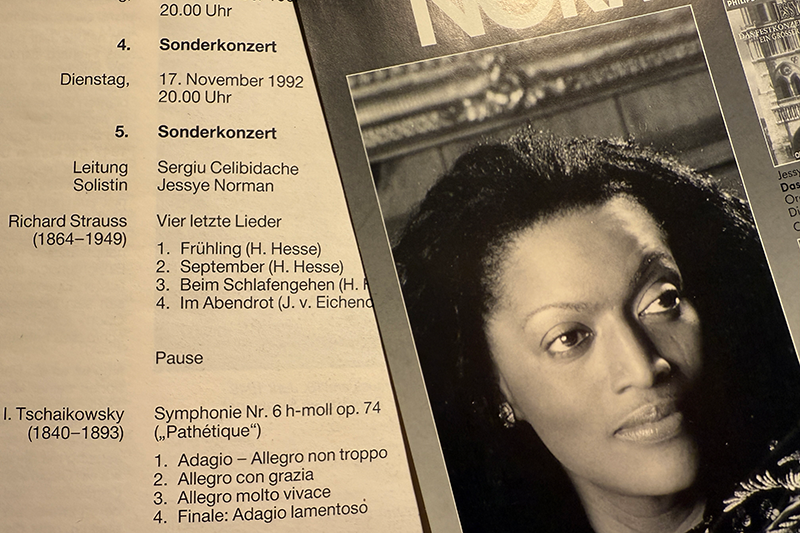
it was frequented by James Levine and Lorin Maazel, Plácido Domingo and José Carreras, Kiri Te Kanawa and Jessye Norman.
In early 2004, “Miss Norman”, as she liked to be called, was preparing for a month-long tour of Japan. On her programme were two rarely performed mono operas: Schoenberg’s Erwartung and Poulenc’s La Voix humaine. The stage director was her close friend André Heller. As the word “mono-opera” implies, there is only one singer on stage during the entire piece. What’s more, the two works were to be performed together in one show, making the project particularly gruelling.
About a month before Norman was scheduled to travel to Japan, she called me (then her personal manager), asking about her travel arrangements. “Tell me, my dear, what hotel am I staying in Tokyo this time?” she asked. Odd question, I thought, as I knew she always stayed at the Capitol Tokyu, but she went on: “Could you find out if the hotel has a pool? I am having trouble walking, and my doctor has told me to go swimming once a day to ease the pain in my knees.”
As soon as she asked about the pool, I knew her hotel almost certainly did not have one, otherwise she would not have asked. Nevertheless, I told her I would find out and get back to her shortly.
Predictably, the Capitol Tokyu did not have a pool. But the promoter came up with an easy solution: there would be a limousine on 24-hour standby, so anytime Norman wanted to go swimming, she just had to take a four-minute ride to a nearby spa. So I called her and told her about the arrangement, convinced that this would solve the issue. Little did I know how wrong I was.
“Car? I have to take a car? Why would I do that? Every other hotel has a pool, you just take the elevator down and that’s it! I don’t want to take a car to the pool!”
There was no reasoning with her in the matter. The Capitol Tokyu Hotel was out of the question, and I had to find her a new hotel with a swimming pool. This would not have been so difficult were it not for the fact that she needed the largest suite available, windows that opened, and a room available for an entire month. To make matters worse, that month was May: cherry blossom season and the favourite time for young Japanese couples to get married, particularly at expensive hotels in Tokyo.
The first solution I came up with was to suggest the Okura, but this was quickly dismissed. Even though the hotel had great suites, with windows to open and a large pool in the building, Norman refused to stay there. Apparently, she had stayed at the Okura before, when one day the general manager knocked at her door, politely asking her to move to a different suite because a “very important” guest was about to arrive. That guest turned out to be the CEO of The Coca-Cola Company. Norman refused, locked herself in the room and vowed never
to return.
Another solution was the beautiful Westin Tokyo Hotel in the Ebisu district, but this was also rejected. During a previous stay, an adult movie had been filmed in the room just above her, prompting her to check out immediately.
The eventual solution I came up with was the newly opened Nikko Hotel in Tokyo’s Odaiba district, close to the ocean. Nicknamed “Tokyo Balcony”, every room had windows to open and even a small balcony. The hotel also had a swimming pool. There remained only one small problem: during the month of May, the hotel’s suites were fully booked.
In a situation like this, most artist managers would simply give up, but Norman’s Japanese management was not so easily defeated. I never found out how they did it, but they somehow managed to rearrange the bookings of every single person planning to stay at the Nikko Hotel during the entire month of her Japanese tour!
Did she use the pool? Once or twice, probably. And the performances? They turned out to be a huge success. As the English science fiction writer Arthur C. Clarke once said: “The only way to discover the limits of the possible is to go beyond them into the impossible.”.
Florian Riem