

Tradition and innovation at the Hong Kong Chinese Orchestra
As it approaches its 50th anniversary, the Hong Kong Chinese Orchestra embarks on a season of cross-cultural encounters and visionary experimentation – where ancient traditions meet tomorrow’s talent, from the breath of a thousand reeds to the baton of a rising star
Entering its 49th season, the Hong Kong Chinese Orchestra (HKCO) continues to push the boundaries of what a traditional orchestra can be. Founded in 1977 and hailed as the “cultural ambassador of Hong Kong”, the orchestra has steadily expanded its remit from preserving heritage to pioneering global musical conversations.
“There is ‘joy’ in the word ‘enjoy’,” notes Artistic Director and Principal Conductor for Life Yan Huichang. It is more than a poetic turn of phrase. In the upcoming season, joy is both a sentiment and a strategy – a force for connection, artistic dialogue, and what Yan describes as the weaving of “musical threads that connect past and present, bridging Chinese and global cultures while offering enjoyment through the arts.”
In the opening work of the 2025-26 season Silken Notes of the Pipa, the orchestra embarks on a musical journey along the Silk Road. The programme features four- and five-stringed pipas, the Japanese biwa and Turkish oud, creating what Yan describes as a “sonic tapestry spanning the Silk Road across millennia”, capturing “the joys and wisdom garnered by the confluence of Eastern and Western civilisations.”

Adding to this diverse offering is the Hong Kong Drum Festival, now in its 21st year. A key part of HKCO’s annual programming since its launch in 2003, the festival is renowned for its visceral energy and cross-generational appeal. Conducted by Assistant Artistic Director and Resident Conductor Chew Hee Chiat, this year’s edition welcomes percussion virtuoso Professor Wang Jianhua from the Central Conservatory of Music. Also returning is the acclaimed Korean troupe The Little Angels, whose drum dance performances electrified last year’s globally livestreamed festival.
This season, the orchestra also delves into cinema, with Hong Kong Cinematic Odyssey: Wu Kong and The Last Dance reinterpreting award-winning films through Chinese music in collaboration with composer and erhu artist Chu Wan Pin. The Allure of Tradition traces the genre’s historical roots, while Music About China of the Hong Kong Arts Festival includes Rhapsody of String Puppets written by Yan Huichang, featuring multi-instrumentalist Wang Kun.
HKCO’s commitment to emerging talent finds its most dynamic expression in Cadenzas of Hong Kong 2.0, co-presented with the Hong Kong Composers’ Guild. The concert includes three new commissions by renowned Hong Kong composers, Chan Wing-wah, Alfred Wong and Hui Cheung-wai.
Meanwhile, Music from the Heart, now in its 27th year, continues as a cornerstone for creative development. Recently extended to the Greater Bay Area, it fosters original composition through professional evaluation, live voting and engagement with student composers via the Education Bureau.
HKCO’s regional touring strategy builds cultural bridges across borders. September takes the orchestra to Dunhuang, evoking the ancient East-West crossroads; October features a headline performance in Seoul during “Hong Kong Week 2025@Seoul”; and in December, the ensemble returns to the Greater Bay Area for a concert in Guangzhou.
Whether found in the intimate vibration of a single reed or the collective power of an orchestra in full flight, the HKCO’s work reminds us that tradition is sustained not by preservation alone, but through constant reinvention. “Chinese music thrives as it passes from one generation to another,” says Yan Huichang. As the orchestra approaches its 50th anniversary, it continues to shape a musical identity that is curious, expansive and resonant with the present.
For more information, please visit www.hkco.org

Rendezvous with the Polish Cello Quartet
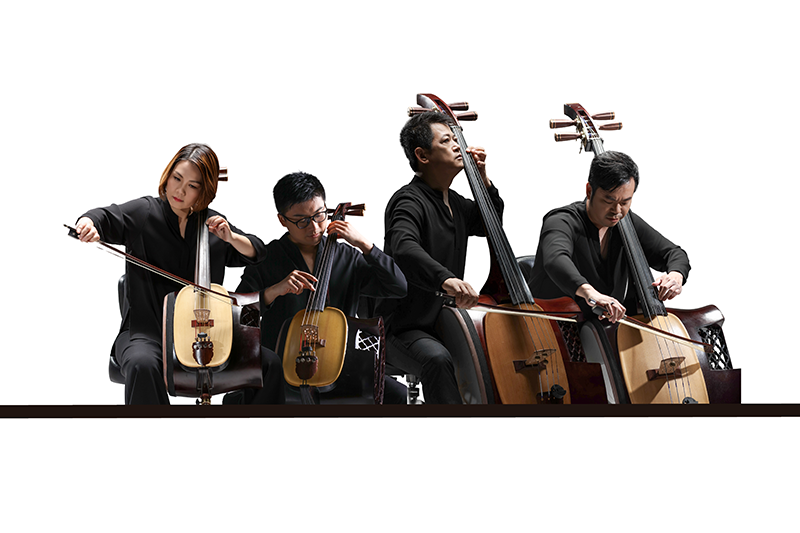
Among the season’s most compelling cultural dialogues is Rendezvous – a new collaboration between the Polish Cello Quartet and HKCO ensemble, born from the orchestra’s acclaimed performance at the inaugural Hong Kong Performing Arts Expo (HKPAX) in October 2024. The concert, which will be recorded by Radio Television Hong Kong and broadcast via the European Broadcasting Union, is not just a meeting of instruments but a merging of idioms.
Involving HKCO’s String Quintet alongside its Eco-Gehu and Eco-Bass Gehu ensembles (sustainable, modernised string instruments developed by the orchestra), Rendezvous explores the expressive overlap between bowed string traditions, with the cello’s robust resonance finding an intriguing counterpart in the mellow depth of HKCO’s eco-instruments.
The programme will feature new commissions by composers from both Poland and Hong Kong, reflecting a musical landscape shaped by exchange rather than dominance. These works interrogate the line between East and West, not as binary opposites, but as a shared canvas.
In July 2026, this collaboration travels to Poland, extending this artistic alliance beyond Hong Kong’s shores. It is a move consistent with the orchestra’s long-standing aim to “bring Chinese culture to the world”.
A Thousand Reeds, One Universe
At the centre of HKCO’s 49th season lies an instrument that predates the orchestra itself by some 3,000 years. The sheng, a polyphonic mouth-blown reed instrument, is the world’s oldest free-reed instrument and a distant ancestor of the harmonica, accordion and organ. This year, it takes centre stage.
The Endless Sheng – International Sheng and Reeds Festival is more than a showcase. Conceived by Yan Huichang as a platform for cultural diplomacy, the festival seeks to reframe the sheng not merely as a relic of ritual, but as a contemporary force for global resonance.The festival unfolds in phases, beginning in spring 2026 with the Endless Sheng, Thousand Reeds in Harmony Marathon at the newly developed Kai Tak Sports Park. Featuring in-person and online events, the programme will unite performers from Hong Kong, mainland China and further afield in an unprecedented musical convergence.
An international symposium and a global sheng competition will follow, culminating in the Thousand Reeds, One Universe concert in September 2026, bringing together the world’s leading sheng artists.
What distinguishes this festival is not only its scope but its symbolism. In an age often defined by digital noise and cultural polarisation, the sheng’s breath-driven sound becomes a metaphor for unity through harmony. While Western instruments like the clarinet or oboe have traditionally evolved as solo voices, the sheng, with its multi-pipe structure, embodies a naturally collaborative sound, blending tones in rich harmonic interplay. It is, in every sense, an ensemble instrument.

Fifth International Conducting Competition for Chinese Music
The HKCO is equally invested in the future of leadership on the podium. Launched in 2011 and held every few years since, the International Conducting Competition for Chinese Music has become a barometer for rising talent in Chinese orchestral music.
The fifth edition, co-hosted with the Wuxi Chinese Orchestra, is accepting entries until 31 August 2025. From an initial round of video-based assessments in December 2025, finalists will proceed through live rounds in Wuxi and Hong Kong, culminating in a public concert at the Hong Kong Cultural Centre in June 2026.
The awards structure reflects both excellence and inclusivity. From the Champion’s Prize of US$15,000 to special awards such as the Musicians’ Choice and Media Award, the competition seeks to reward artistry as well as audience and ensemble rapport. Previous editions have welcomed contestants from as far afield as Poland and Italy, underscoring its growing international reach.
“From wielding the baton to communicating with the musicians of the orchestra, to stepping onto the conductor’s podium and feeling the tension of having all eyes on one’s every single move, it has been a most valuable experience for aspiring conductors,” reflects Yan Huichang. “We look forward to organising this kind of competition in the future so as to give young conducting talents of Chinese music the break they deserve.”
