

In Taitung, Taiwan, an international exhibition brings together seven curators and around 40 artists from across the Pacific to explore cultural heritage, environmental change and Indigenous rights
Maps may place the islands of the Pacific far apart, but their histories tell a different story. For thousands of years, ocean voyages have connected communities through the movement of people, languages and traditions. These longstanding relationships are the starting point for Moana: Across the Ocean – From the Sea We Come, To the Islands We Return, an international contemporary art exhibition at the National Museum of Prehistory in Taitung, Taiwan. Bringing together artists and curators from across the Pan-Pacific region, the exhibition considers how shared cultural histories and Indigenous knowledge can inform responses to contemporary global challenges.
The exhibition draws on Pacific scholar Epeli Epeli Hauʻofa’s concept of Our Sea of Islands, which challenges the perception of Pacific islands as isolated territories separated by vast stretches of water. Instead, Hau‘ofa viewed the ocean as a network connecting communities through common histories, cultural practices and ancestral knowledge. This understanding provides the foundation for Moana, meaning “ocean” in many Polynesian languages. Taiwan occupies an important place within this history. Its Indigenous peoples share linguistic and cultural connections with Austronesian communities whose migrations over thousands of years extended across the Pacific and Indian Oceans, from Madagascar to Rapa Nui. For the exhibition’s organisers, these connections provide an opportunity to strengthen relationships across the region while establishing Taiwan as an international centre for artistic exchange.
Part of the Pan-Pacific Triennial, a contemporary art project initiated in Taitung, the exhibition opened at Taitung Art Museum in June 2026, attracting more than 50,000 visitors during its initial presentation. Its second phase opened at the National Museum of Prehistory on 16 October, presenting a programme of artistic collaborations, installations, performances and multimedia works.
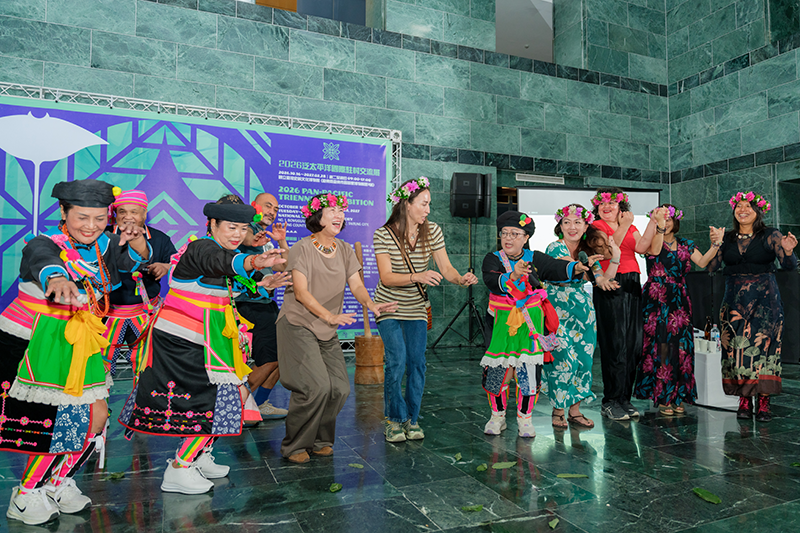
The curatorial team includes Shu-Lun Wu, Simon Lee and Yunyi Lee in Taiwan, Josh Tengan in Hawaii, Nina Tonga in Aotearoa New Zealand, Merv Espina in the Philippines and Reuben Keehan in Australia. Working with around 40 artists from across the region, including Japan, Indonesia and other Pacific island communities, the curators have developed a programme centred on research, dialogue and residency-based artistic practice. Rather than simply bringing together works from different cultures, the project encourages artists to exchange knowledge and develop new perspectives through collaboration.
Four interconnected themes underpin the exhibition: climate change and the ocean crisis; Indigenous rights and cultural identity; global migration and inter-island communities; and multilingualism and cultural exchange. Together, they address the environmental, political and social pressures facing Pacific communities, from rising sea levels and resource extraction to the preservation of ancestral knowledge, languages and traditions.
These concerns find expression through a wide range of artistic practices, including sculpture, textiles, sound, video and performance. Among the collaborative works is Whispers of Taitung, a barkcloth piece created by New Zealand-based Tongan artist Tui Emma Gillies and her mother, barkcloth expert Sulieti Fieme‘a Burrows, working with Taiwanese Indigenous barkcloth master Panay from Dulan. Using material derived from the paper mulberry tree, which has longstanding cultural significance across Austronesian communities, the artists explore the movement of people, knowledge and traditions between islands. The work draws on a shared craft heritage to consider the themes of departure, return and cultural continuity.
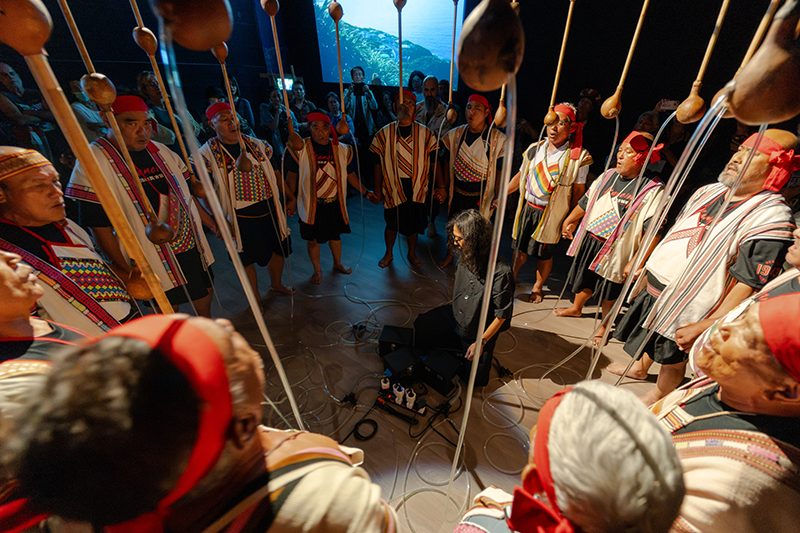
Environmental change and community resilience are central to Eight Windows and Love Letter to Millet by Taiwanese Rukai artist Eleng Luluan. Developed during a residency in Hawaii, the work draws parallels between the environmental challenges facing communities in Taiwan and Hawaii. Through wooden structures and woven materials, alongside imagery of millet and volcanic landscapes, Luluan explores the relationship between land, cultural memory and collective responsibility. Her work considers how communities maintain their identities and connections to place in the face of increasingly unpredictable environmental conditions.
The relationship between Indigenous knowledge and environmental justice also informs The Deontic Hento, a collaboration between Indonesian artist Nursalim Yadi Anugerah and West Kalimantan musician Abang Bunau, a master of the kadedek, a traditional mouth organ. Constructed from bamboo and other natural materials sourced from customary land in Engkurai village, the installation incorporates 18 bamboo tubes that produce sounds as air passes through them. As the organic materials age, the sound evolves, drawing attention to the relationship between traditional knowledge, ecological resources and the rights of Indigenous communities to protect their ancestral lands.
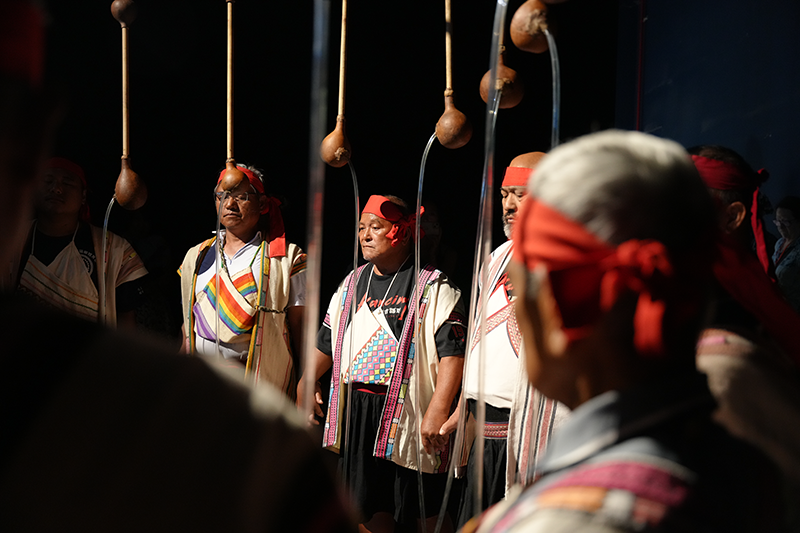
Performance offers another perspective on the relationship between individual and collective identity. The exhibition’s October opening included Made in Taiwan, a collaboration between Australian artists Brian Fuata, Latai Taumoepeau and Bhenji Ra, featuring Lucreccia Quintanilla. Moving between sound, physical movement and moments of stillness, the performance explored the shifting relationships between individuals and the collective, reflecting the exhibition’s wider emphasis on cultural exchange and transformation.
Beyond the individual works, the residency programme reflects Taitung’s ambitions to develop lasting international cultural relationships. Bringing together artists and curators from different countries and Indigenous communities positions Taitung as a meeting point for contemporary artistic practice and the exchange of cultural knowledge. For Taiwan, whose Austronesian heritage provides connections to communities across the Pacific, such initiatives offer opportunities to strengthen its international cultural profile and build networks that extend beyond the exhibition itself.
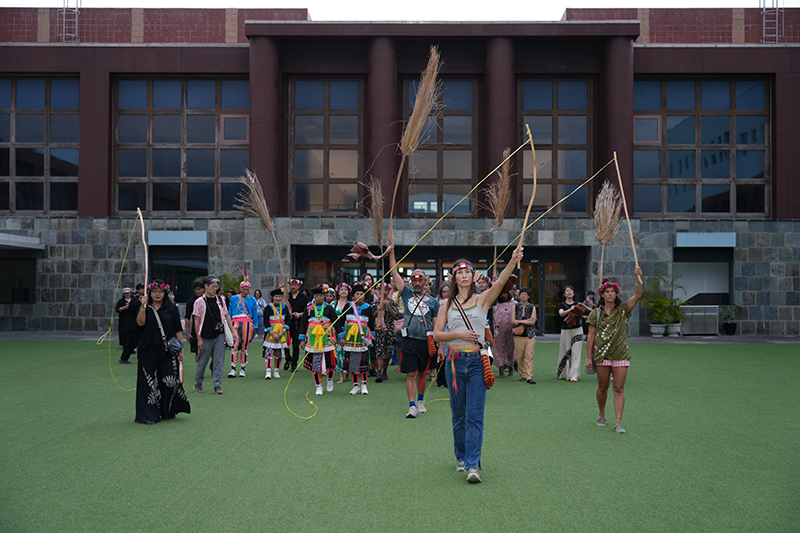
Taken together, the works connect shared histories with questions of contemporary significance: how communities protect their ancestral lands, how cultural knowledge is passed between generations and how island populations respond to environmental change. Rather than offering a single answer, Moana brings different perspectives into conversation, demonstrating how international artistic collaboration can connect local experience with concerns that extend far beyond the Pacific.
The exhibition continues until 28 February 2027. For more information, visit nmp.gov.tw/en