

Esplanade – Theatres on the Bay sits at the heart of Singapore’s cultural life. CEO Yvonne Tham reflects on how the centre is breaking down barriers and reimagining what an arts venue can be in the 21st century. In conversation with Florian Riem
Esplanade – Theatres on the Bay is a landmark in Singapore and well-known across Asia, but perhaps less so in Europe. What sets Esplanade apart from arts institutions like Lincoln Center or the Barbican?
The development of multi-venue arts centres in Asia is relatively recent, with many emerging over the last 40 years alongside rapid economic growth. By contrast, Europe and the US have a far older tradition of concert halls and opera houses, with multi-venue arts centres becoming more prominent post-World War II, often as part of urban revitalisation.
When you look at these institutions, one key difference is that Esplanade does not have resident companies—no permanent orchestra, ballet or opera. This was a conscious decision so that we could reflect our cultural diversity and not be defined by a single artistic tradition. Esplanade was conceived as both a symbol of Singapore’s identity as a
global city, but also a space that embraces the diversity of
Asian cultures.
Another key difference is the role of free performances. Many Asian artistic traditions and practices have their roots in communal celebrations held in town squares or temples. Our Concourse and Outdoor Theatre provide a similar communal area, which makes them so special. Unlike many venues that only activate public areas during special festivals, we’ve programmed free indoor and outdoor performances every
day since 2003. Being in the tropics means we can do this all year-round—we don’t need a summer festival!
Although you don’t have a resident orchestra, the Singapore Symphony Orchestra regularly performs at Esplanade…
Yes, the Esplanade Concert Hall serves as the Singapore Symphony Orchestra’s “performing home”, and we are happy that they have also recently moved their offices to the Esplanade Mall. We also support and collaborate with the Singapore Chinese Orchestra, Malay and Indian ensembles, as well as many overseas groups. Our spaces adapt to diverse art forms. Last month, we hosted a Korean sacred ritual on our main stage. A couple of years ago, we transformed the same space into a Taoist temple setting.
When Esplanade opened in 2002, critics questioned its mix of restaurants and arts.
Yes, people joked, “Only Singapore would put a mall in an arts centre!” But today, integrating these lifestyle elements has become quite common around the world for new arts centres. For us, it was all about meeting our community in familiar, everyday spaces: eating out is a central part of Singaporean life. And of course, the restaurants bring a great buzz to the centre. For the next four years, we’re even hosting the Registry of Marriages at Esplanade! Couples get married here, have their wedding lunch at one of our restaurants, and may even hear a rehearsal echoing through the concourse as they leave.
It’s all about removing barriers—you don’t need to “understand” art to feel welcome. It’s different in Europe and America, where notions of “high culture” or a “temple of art” still persist. Here, we don’t have that single temple of art. But in a way, we reflect the traditions of always having had “the arts in a temple”.
How far has Esplanade come in its vision of being an “arts centre for everyone”?
We’ve come quite a way in 22 years—from about 1.3 million annual attendees (paid and free programmes) in our early years to about 3.8 million attendees in our last financial year, as well as shifts in how different generations engage with the arts. But obviously, certain challenges remain, especially for under-25s. They consume global content digitally—so what is it that an arts centre can do to spark their interest beyond Netflix or TikTok? That’s the key challenge. I’m sensitive to the next generation as my first job was as a teacher, so I’m always thinking: what is a 10-year-old experiencing today? And how does that shape them when they’re 20? And how can the arts be part of that personal development?
With your literary background, how do you approach programming across so many art forms?
We’re a centre for everyone, we’re very diverse, and this is reflected in the people who work at Esplanade. It’s less about me than about building a diverse team that really reflects Singapore’s multiculturalism.
My personal interest lies in art’s societal impact—be it on mental health, ageing or more vulnerable communities. We’re even exploring an “arts social prescription”, where we partner with hospitals.
Singapore is a very small country, which allows us to bring ideas to life more quickly—unlike Europe, where larger bureaucracies and multiple layers of government can slow things down. Here, we’re one state and one country, which gives us greater flexibility and responsiveness.
Social prescription for the arts is something I hope Esplanade can help champion in Singapore. The aim is to be able to have people come to the arts centre to experience performances and also interact with teaching artists in ways that support their return to a better state of life.
I think my literary background contributed to all this, because when you read literature, you empathise, right? You’re always in somebody else’s world. That’s why I feel so connected to Esplanade’s mission to be a centre for everyone.
How do you deal with controversial projects or proposals you personally dislike?
We have a set amount of resources, so we have to weigh artistic merit against resources. If a proposal is costly but vital, we strategise pricing and sponsorships. We have to support a wide range of local arts companies. I don’t get directly involved in the decision, but I try to get our teams to think about long-term investment, to really understand a company’s or an artist’s vision and commit to it, while managing our investment wisely.
Singapore is big on inclusion and diversity because it’s one of the basic tenets of our society—our social fabric would unravel without that belief. So, while in the rest of the world there may be some resistance, here I sense an even stronger push for inclusion.
When we are encountering sensitive content and topics that are potentially controversial, we try to create “safe spaces” within the theatre. To confront certain topics, we would have an artist talk after a show, with different views on the panel but with a neutral moderator. We also think about how we talk about a work before a show: we try not to fire up conflicting views but try to shape the attitude of the audience as they enter the theatre—not to divide, but to build a bridge. Our role is fostering dialogue, not division.
Take Esplanade’s A Tapestry of Sacred Music festival, for example: we have performances that include Christian, Islamic, Hindu and Buddhist traditions, sharing the same physical stage at different times of the day. Art can bridge divides without escalating conflict.
During the 11 years of your tenure, was there a personal moment that shaped you particularly?
Once, a woman in her 90s sent me a handwritten card (it’s so rare to get anything handwritten, right?)—she’d attended our evergreen concerts for years and wanted me to give her a call. On a landline, not a mobile! She turned out to be a lovely lady, and I had a few exchanges with her. She talked about her youth, how she loved music, the foxtrot and ballet. When she fell terminally ill, I asked her, “If you get better, what would you like to do most?” And she replied that she would like to come back to a concert or maybe get in a boat and sail around the bay. Then, in the end, she looked at me and said: “But maybe I won’t be able to dance again.” She was a really inspiring and independent woman. The arts gave her that sense of independence and the ability to express herself. It was a powerful reminder of why our work matters and how deeply the arts can shape a life.
To discover more about Esplanade, visit: esplanade.com
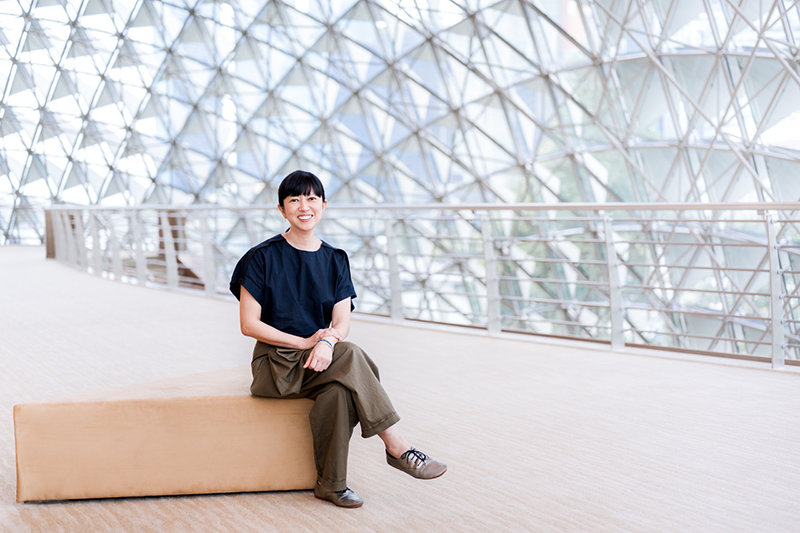
Yvonne Tham is the CEO of The Esplanade Co. Ltd, where she leads the overall management and programming direction of Esplanade – Theatres on the Bay.
Previously, Tham was Deputy CEO of Singapore’s National Arts Council and Director of the Arts and Heritage Division at what is now the Ministry of Information, Communications and the Arts. In these roles, she helped shape the 2000 “Renaissance City Plan” and was instrumental in establishing the School of the Arts, DesignSingapore Council, and National Gallery Singapore. Tham has also worked at the Ministry of Manpower and taught literature at Raffles Junior College.
Tham currently sits on the boards of the University of the Arts Singapore (UAS), Nanyang Academy of Fine Arts (NAFA), SISTIC Singapore and the Singapore International Film Festival. She is Chairperson of the Association of Asia Pacific Performing Arts Centres and a board member of the International Society for the Performing Arts (ISPA).
